
The phenomena of habitat encroachment, fragmentation and loss/destruction have a massive impact on the natural world and is a hallmark of the human species. Increased intelligence, increasing population and the development of economics based on maximum resource utilization has driven us into uncharted territories for much of the last century. While this has boosted our way of living, the rest of the natural world has suffered. Let me put this into perspective for you-
How would you feel if a group of unknown hooligans barged into your house and took up the entire living room to stay and work from? Not good, I’m thinking. But let’s say you have no option. You let them be and make do with living in your bedroom and using the bathroom and kitchen.
But wait! These guys soon decide that they also need to cook! So, they decided to come into your kitchen as well. You try to stop them, but they cut you off. Now, you are pretty much stuck with your bedroom and bathroom. Well, I guess you could cook in your room. You decide to adjust some more…..
These guys continue to barge into your space. They decide they need the bathroom more than you do. Now all you have access to are your bedroom and the front door. What will you do?

The impacts…
Habitat fragmentation has 4 clear effects; (1) reduction in the number of habitats, (2) reduction in size of the habitats, (3) increase in the number of habitat patches and (4) increasing isolation of these patches.
The biggest and the most obvious consequence of our encroachment has been less space, for other animals and plants to colonize. Everywhere in the world, forest areas are shrinking. Coral reefs are lessening in extent because of direct and indirect impact of human activities (see here). More and more species are being cramped into smaller natural spaces, increasing both inter-species and intra-species competition for limited resources.
Encroachment eventually leads to fragmentation; breaking habitats into smaller and more distant patches. This has a multitude of effects. Seed dispersal pattern gets erratic and inefficient because the intervening area between habitats are not suitable for growth anymore. The chances of land degradation increases because a fragmented habitat leaves the land susceptible to erosion. We also face the risk of natural disasters.
There is more pressure on animals to find food and shelter and increased risk of coming in contact with humans. This directly relates to Human-Wildlife conflicts. The single biggest reason for these conflicts are habitat encroachment and fragmentation.
Eventually, the habitat or landscape becomes so fragmented that the it cannot support a larger-scale ecosystem; the habitat is lost. This leads to the loss of biodiversity. Out of the four major causes of biodiversity loss (the others being invasion of alien species, pollution and over-exploitation of resources), habitat destruction is the biggest reason. The reason is straightforward; in the process of encroaching, we kill a huge number of organisms. This includes plants and insects and microbes. After encroachment, we further prevent the reestablishment of plant and animal colonies. And by fragmenting the habitat, we decrease connectivity between the patches of livable land.
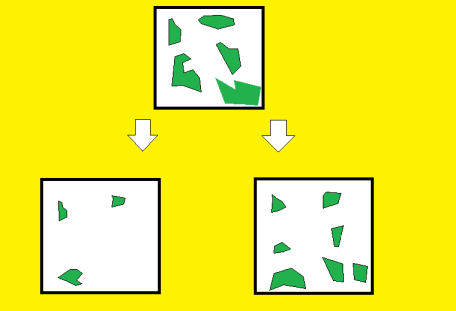
However, it is important to note that fragmentation is different from “habitat loss”. Habitat loss is the complete destruction of habitat and is an extreme scenario. While fragmentation allows for some accommodation of other life forms, habitat loss leaves no breathing space. Both fragmentation and habitat loss are issues that need to be tackled when we plan our resource management activities. A few simple considerations will go a long way in curbing the effects of this two phenomena. The first and the foremost step is Land Use Planning, which is fast becoming an important aspect of landscape ecology today.
Discover more from Eco-intelligent
Subscribe to get the latest posts sent to your email.
 Eco-intelligent
[…] through forested areas. This causes serious habitat fragmentation. I’ve written about the dangers of habitat fragmentation […]
LikeLike
[…] actively compete with other grazing herds that are raised for meat. Their habitats are also being fragmented by road and railroad construction […]
LikeLiked by 1 person
[…] extinction of species occurs due to habitat fragmentation, invasive species, pollution and over-exploitation of resources. However, species can adapt to […]
LikeLiked by 1 person
[…] that has been created through evolution. Largely, this threat is because of human activities of habitat destruction, fragmentation, invasion and over-exploitation. The urgent need for conservation of this diversity is because it […]
LikeLiked by 1 person
[…] of the ways that humans increasingly intersect with nature is through habitat encroachment. It’s a common theme: humans move into an area, change it to suit themselves, and push other […]
LikeLiked by 1 person
[…] week’s mid-week post discussed one of the major ways we humans intersect with nature: habitat encroachment. Today I’d like to look at a more positive form of interaction–and weirdly […]
LikeLiked by 1 person
[…] an area turns from a dense forest to a fragmented landscape, it is possible that the open areas would promote groundwater […]
LikeLiked by 1 person
[…] kilometers. As convert the natural landscape into farmlands, pastures, cities and roads, we are fragmenting the home ranges of these large mammals. The Earth lost 1 football pitch of forest land every second in 2017, equivalent to the size of […]
LikeLike
[…] is otherwise called habitat fragmentation. We take a landscape and begin to use it for a variety of purposes at the same time. This creates […]
LikeLike
[…] three large scale changes: (1) the shift of suitable habitats northwards (or upwards); (2) a reduction in the size of the habitats and; (3) […]
LikeLike